

The Press Release:
People have been fascinated by sharks for as long as we have been exploring the oceans. Fixed in the public imagination as toothy, fearsome predators, sharks are far more fascinating, and more complex, than their depiction in popular culture. Sharks, a new exhibition opening at the American Museum of Natural History this winter, will bring to life the incredible diversity of this ancient group of fishes and will offer visitors a unique look at pre-historic and modern shark species, their habitats and hunting styles, and the conservation threats these magnificent animals are facing today.

The evolutionary history of sharks began nearly 450 million years ago, more than 200 million years before the first dinosaur. Today, there are more than 500 species of sharks and more than 650 species of their close relatives—rays, skates, and chimaeras—inhabiting nearly all of the world’s aquatic environments, from coral reefs to the polar seas, and even freshwater rivers. While the terrifying monster from the movie Jaws is what many might imagine when they think of sharks, today’s scientists are uncovering many surprising facts about this diverse group. Convinced that all sharks are carnivores? (Fact: Recent research shows that bonnethead sharks eat seagrass and can digest plants). Where do great white sharks give birth to their young? (Fact: By tracking females, scientists recently discovered a great white shark nursery off the coast of Long Island, New York). Can shark tourism be more profitable than shark fishing? (Fact: where fishing and ecotourism are regulated, tourism can support shark communities for generations. In fact, a single whale shark has been shown to bring thousands of more dollars as a beacon for tourism than could be earned by killing it). Sharks addresses these exciting questions and reveals more secrets of the ocean’s top predators through lifesized models, touch-free interactives, real fossils, and dynamic media presentations.
Visitors to Sharks will explore the diversity, anatomy and behavior of sharks and their close relatives through encounters with tiger sharks, great whites, and other familiar favorites along with little-known creatures such as the torpedo ray, the longnose chimaera, and the tiny dwarf lantern shark, which glows in the dark and is small enough to hold in your hand. The exhibition will showcase fossils from the Museum’s extensive collections, current Museum research, and a spectacular “parade” of sharks highlighting the diversity of ancient and modern shark species through 30 lifelike models that range from 33 feet to 5 inches long, including the prehistoric megapredator megalodon, the “Tyrannosaurus rex of the seas,” which was so large it preyed on whales. Other exhibition highlights include an interactive that challenges visitors to hunt like a hammerhead and touch-free media that reveals distinctive shark traits with the wave of a hand. Sharks also delves into the serious conservation issues facing sharks today, including overfishing and habitat destruction, demonstrating that while these amazing animals pose few threats to people, we represent a serious danger to them.
Sharks is curated by John Sparks, curator in the Museum’s Department of Ichthyology in the Division of Vertebrate Zoology, who previously curated Unseen Oceans, which explored the latest ocean science, and Creatures of Light: Nature’s Bioluminescence, which focused on the diversity of organisms that produce light. He also co-curated Life at the Limits: Stories of Amazing Species, about organisms with surprising abilities and those that thrive in extreme habitats. Sparks’ recent research explores the role that bioluminescence and biofluorescence play in the diversification of both shallow-reef and deep-sea fishes. His current projects include investigating the evolution and function of bioluminescent signaling systems in ponyfishes (Leiognathidae), lanternfishes (Myctophiformes), and dragonfishes (Stomiiformes), the origins of Madagascar’s freshwater and nearshore marine fishes, and the evolution and function of biofluorescence in marine fishes. Sharks has also drawn on the expertise of John Maisey, curator-in-charge emeritus, fossil fish, Division of Paleontology, whose research focuses on early chondrichthyans and shark evolution.
Sharks will open to the public on Wednesday, December 15, 2021. Museum Members will be able to preview the exhibition from Friday, December 10, through Sunday, December 12
American Museum of Natural History (amnh.org):
The American Museum of Natural History, founded in 1869, is one of the world’s preeminent scientific, educational, and cultural institutions. The Museum encompasses more than 40 permanent exhibition halls, including those in the Rose Center for Earth and Space, and the Hayden Planetarium, as well as galleries for temporary exhibitions. The Museum’s scientists draw on a world-class permanent collection of more than 34 million specimens and artifacts, some of which are billions of years old, and on one of the largest natural history libraries in the world. Through its Richard Gilder Graduate School, the Museum grants the Ph.D. degree in Comparative Biology and the Master of Arts in Teaching (MAT) degree, the only such freestanding, degree-granting program at any museum in the United States. The Museum’s website, digital videos, and apps for mobile devices bring its collections, exhibitions, and educational programs to millions around the world. Visit amnh.org for more information.
Hours
The Museum is open Wednesday-Sunday, 10 am–5:30 pm. The Museum is closed on Thanksgiving and Christmas.
Admission
Museum admission is free to all New York City school and camp groups.
New York, New Jersey, and Connecticut residents (with ID) have the option to pay what they
wish for General Admission; the reservation must be made online and the transaction must be
completed at a Museum ticket counter.
General Admission, which includes admission to all permanent exhibition halls and the Rose
Center for Earth and Space but does not include special exhibitions, giant-screen 2D or 3D
film, or Space Show, is $23 (adults), $18 (students/seniors), and $13 (children ages 3–12). All
prices are subject to change.
General Admission Plus One includes general admission plus one special exhibition, giantscreen 2D or 3D film, or Space Show: $28 (adults), $22.50 (students/seniors), $16.50 (children
ages 3–12).
General Admission Plus All includes general admission plus all special exhibitions, giantscreen 2D or 3D film, and Space Show: $33 (adults), $27 (students/seniors), $20 (children ages
3–12).
Health Protocols
The Museum maintains COVID-19 protocols to protect the health and safety of visitors and has taken steps to maintain a safe environment, including requiring facial coverings for visitors ages 2 and up and upgrading ventilation. As of August 25, 2021, in accordance with the New York City vaccination requirement, visitors ages 12 and older must be vaccinated against COVID-19 to enter the Museum and show proof of vaccination. Personal identification is required for visitors ages 18 and over. Visit amnh.org/plan-yourvisit/covid-19-visitors-staff for more information about these and other health and safety protocols.
*** end of transmission ***
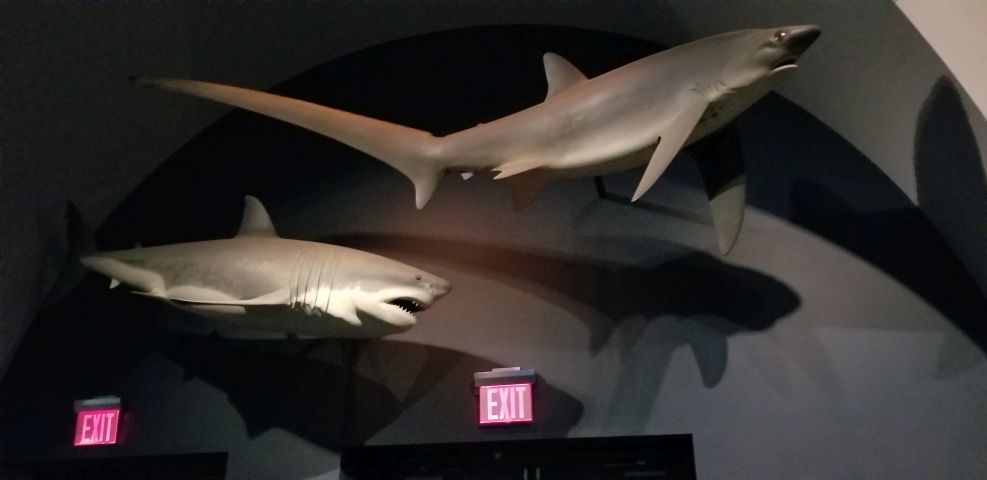
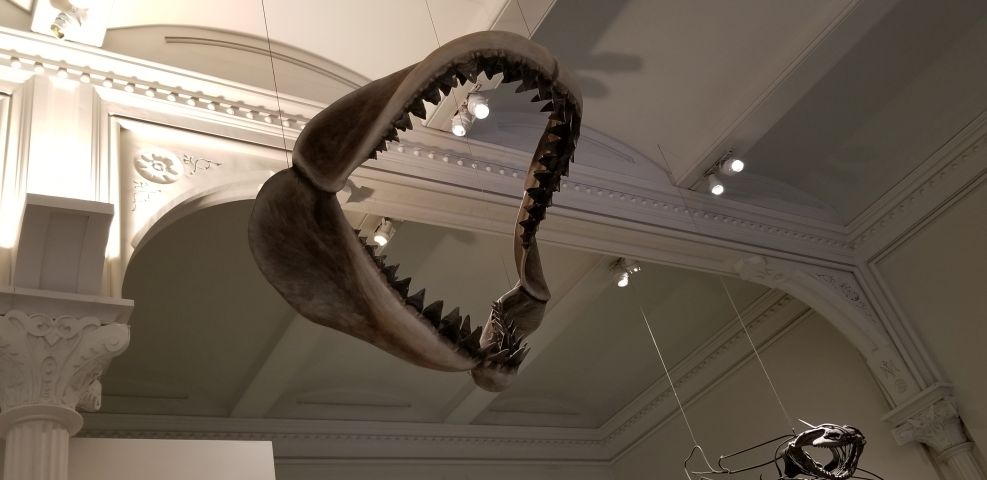
Piercing Ken Thoughts: This one sounds interesting and as much as I am fascinated by the dinosaurs, I am also quite interested in sharks and especially the Great White ones. Of course I keep this fascination to the comforts of my own home and on TV programs and films and never by going into their own territory of the deep blue sea. I am sure that they are quite fine without the likes of me in there. Now while I am interested in checking this out I am not sure how fast I will be able to do so and this is based on the ongoing pandemic. Sure I am now vaccinated but I will be starting up some COVID Safety work very soon to help make sure that others are following the guidelines that have been put out there. It will likely change my flexibility but I will reach out to the museum about attending on a hopefully very empty day. I was glad that this notice had some artwork to share but once again there was no exhibit preview images to bring to your attention so I did what I opted to do in the T-Rex exhibit post and that was to share two exhibits featuring sharks that I snapped in the museum on one of my visits. With this exhibit doing something with Megalodon, I was excited to have an image of their jaws that hang high above the patrons not too far from the dinos. I’ll wrap up now and let you tell me what you think about this new offering. This time around they do share some prices and having been there a number of times think that the one that includes a special exhibit like this AND a Space Show is the most bang for your buck but I say that since I love the Space Shows and being in the Planetarium. Okay that’s all I have now so I will take my leave. You folks please keep safe out there as we are not out of the woods yet and I don’t want anything to happen to my friends. Take care and I will be back with more as soon as something worth sharing comes to my attention.
Official: https://www.amnh.org
Facebook: https://www.facebook.com/